| |
a brief biography
George Halford Fellowes Prynne was born on April 2nd 1853 at Wyndham Square,
Plymouth, Devon. He was the second son of the Reverend George Rundle Prynne and
Emily Fellowes. As well as his elder brother, Edward Alfred, he had a brother,
Albert Bernard (known as Bernard), and two sisters. His father was a well-known
figure in religious circles of the time, being outspoken in his support of the
revival of so-called high churchmanship in the Anglican Church, and espousing
the views of the Oxford movement.
Very little information is available to give an idea of George Fellowes Prynne’s
childhood. However, he cannot have failed to be influenced by his father’s
constant striving and indomitable spirit. St. Peter’s was a church with a
mission, and by all accounts Prynne senior was heavily involved in education,
ministry to the sick, supporting the poor and preaching the gospel. He was aided
by a community of Sisters, on whom fell much of the day-to-day work of the
church in what was a very deprived area.
George junior was sent away to school, first of all to St. Mary’s College,
Harlow. He went on to Chardstock College, and thence to Eastman’s Royal Naval
academy at Southsea.
An impression of his life as a young man can be obtained from Prynne’s own
notes, which were current on his 44th birthday in 1897. It is clear that
architecture was not a profession that he had countenanced from an early age.
Indeed, he spent some time studying privately with a tutor near Oxford with a
view to becoming ordained, but, as he puts it
…difficulties arose as to the expense of a University education.
He first became interested in the study of architecture when his brother Edward
was aiming to enter the office of George Edmund Street, R.A. Little did he know
at that time what an important influence that eminent architect was to have on
his life. George Fellowes Prynne takes up the story:
At the age of 18….an offer came from an uncle, to get me a berth with a nephew
of his who had taken land, and was farming in the Western states of America. I
started on my new life’s career. The experience of Western farming life was both
trying and severe, especially during the last nine months of the nearly 2 years
spent in the then wild West. 26 years ago the states of Iowa and Nebraska
presented a very different aspect to what they do at present….
It was in these parts that one got one’s first experience in practical building,
from log houses and barns, to a more respectable kind of brick and wooden house.
It was here that I was initiated into the Mysteries of door and window-sash
making – rough, but strong and practical.
Seeing the uselessness of throwing my life away in these parts, and that few
Englishmen succeeded in making more than a bare living, and yet not wishing to
return home like a bad penny, I started for Canada, landing at St. Catherines in
winter of 1872, but I could obtain no employment. So I went on to Toronto, where
I obtained temporary work in the office of an architect in the small way of
business, but later on, through the introduction of the Rev. Darling upon whom I
had called, I got a place of Junior Assistant in the office of one of the best
known Toronto architects, R. C. Windyer, who was at the time carrying out new
Custom House buildings for the government.
The terms of my employment were to work for what I was worth, and very little it
must have been at the time, considering that my only credentials were my natural
taste for drawing and my experience in the Wild West. But work I did for dear
life…. With the kindness and sympathy that it would be hard to exaggerate, Mr.
Windyer helped forward my studies giving me the use of his library and
drawings….
By January 1875 I had gained a senior position in the office, and it was shortly
after that my father received an offer from the late G. E. Street, R.A., to take
me into his office.
I may here remark as a point of interest that my father gave Mr. Street his
first church, and that he (Mr. Street) had often expressed his gratitude to him
for giving him this start, as the immediate outcome was 3 other churches in
Cornwall.
On my return from America I worked in Mr. Street’s office during 1875 and 1876,
in after years, working with Swinfern Harris, R.J. Withers, A. Waterhouse R.A.,
and at the London School Board offices. I was a student at the Royal Academy
1876 and 77-78.
Fellowes Prynne set up in his own practice in 1880, stating that his first work
“of importance” was the building of his father’s church, St. Peter’s, Plymouth.
The sanctuary, which was already built, was by G. E. Street, and thus the link
between the lives of Street and Fellowes Prynne continued.
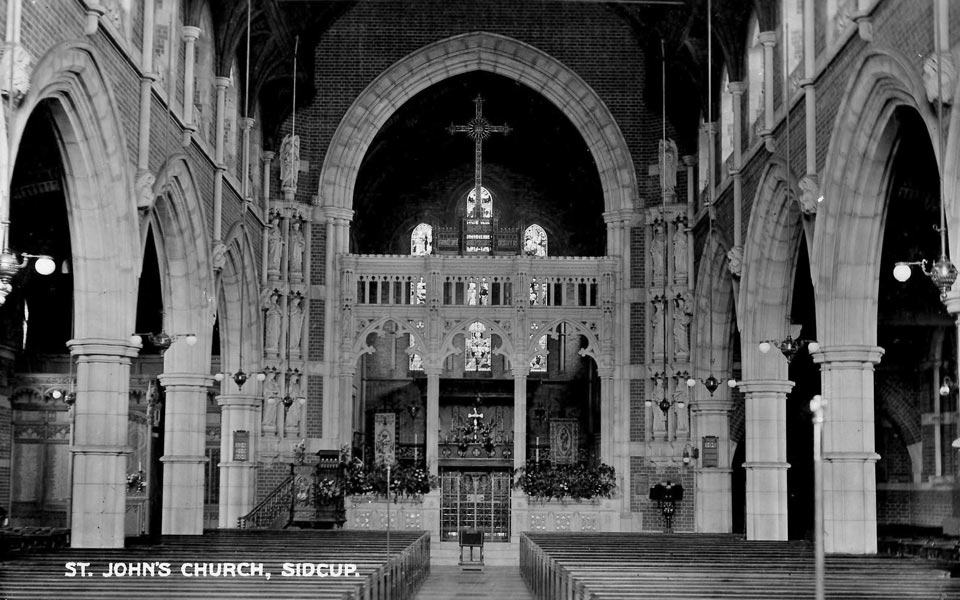
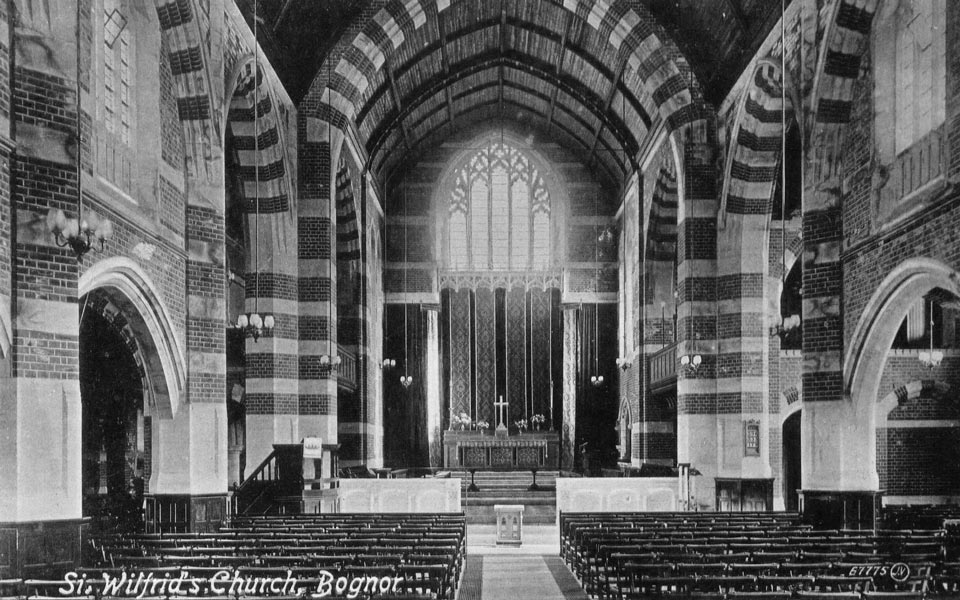
He went on to design many parish churches in England, mostly in the South East
and South West, and almost always on a grand scale of high-church Gothic
revival. He also did much restoration work, and in all is said to have been
involved in over 200 buildings – though I haven't traced all of these!
George Fellowes Prynne was a deeply religious man – family prayers were said
daily for the whole household – and this deep sense of faith is communicated so
clearly in all his work. He was totally committed and totally dedicated, not
just to the use of his skills as an architect and designer, but to the greater
whole that he, through his skills, was striving to express. Particularly in the
latter years, he was heavily involved in the life of his parish in Ealing, being
on the Ealing Ruri-Decanal Conference, the Parochial Church Council and the
Ealing Education Committee. He was also a sidesman at St. Saviour’s Church.
Fellowes Prynne was also totally dedicated to his family, and family life was
not without tragedy. He never recovered from the loss in the First World War of
two of his sons, Edgar and Norman, and serious injury to sons Aubrey and Harold.
His designs subsequent to this catastrophic event were almost exclusively war
memorials, up to his death on the 7th May, 1927. To conclude, it is
appropriate to reproduce Sir Edward Clarke’s obituary to Fellowes Prynne,
published in the monthly magazine of St. Peter's church, Staines.
In Memoriam
GEORGE FELLOWES PRYNNE
All who are, or at any time have been, interested in our beautiful Church, will
have heard with regret of the death of its gifted architect. George Prynne was
the eldest son of the revered and beloved Father Prynne, who was for fifty years
vicar of St. Peter’s, Plymouth. For twenty of those years he was my kind and
faithful friend, and when the time came for the division of the Parish of
Staines, and the building of a new Church, it seemed natural that the name of
St. Peter should be used here, and that the son of my old friend, who had
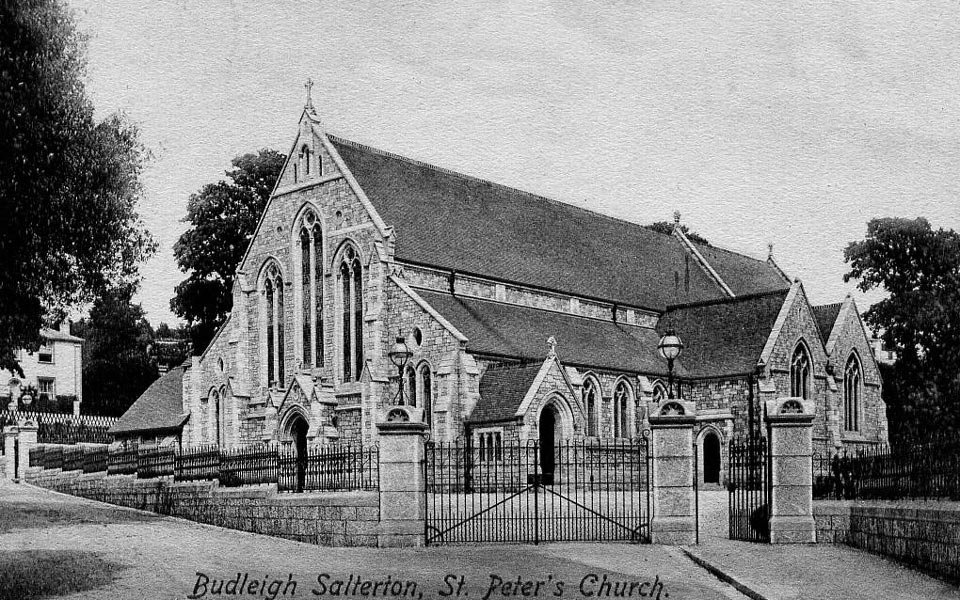
already at Plymouth and at Budleigh Salterton shown a special capacity for
ecclesiastical architecture, should be entrusted with the duty of designing the
new building and superintending its erection.
He performed that most congenial task with a skill that amounted to genius,
and an untiring diligence in supervising every detail of the work, even the
dossal and frontal and the sanctuary kneelers and cushions were designed by him.
And his success at Staines had not a little to do with him being afforded
subsequent opportunities of showing his great qualities as an architect. At
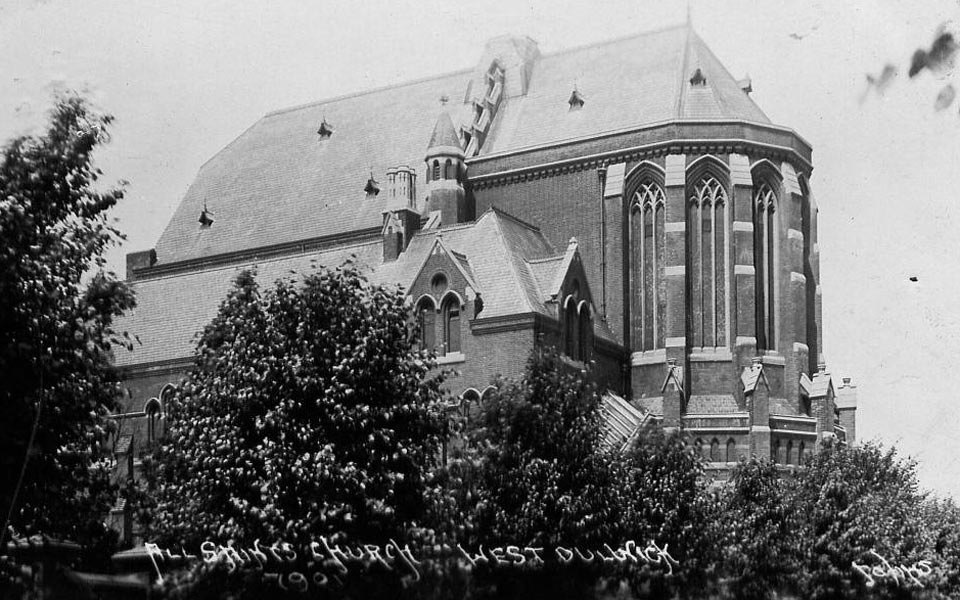
Roehampton and Dulwich and Bournemouth and Ealing there are notable examples of
his skill, at Columb [sic] there is a partially erected cathedral, which if
completed according to his designs, will be a notable example of the expression
in architecture of religious devotion. His life and work were cruelly shadowed
by the great war. The building of beautiful churches appears for the time to
have ceased. And two of his sons gave their lives for their country. Through it
all he was a Christian gentleman; modest, kindly, diligent and patient. His
brother, Edward, eminent in another form of devotional art, supplied the
beautiful windows of our Church, and before his death, completed the designs for
the windows still unfilled. And St. Peter’s stands as a worthy monument to the
two brothers.
May 1927 EDWARD CLARKE |